But when you ask God, you must believe and not doubt. Anyone who doubts is like a wave in the sea, blown up and down by the wind. Such doubters are thinking two different things at the same time, and they cannot decide about anything they do. They should not think they will receive anything from the Lord. James 1:6-8
Everyone lies to his neighbors; they say one thing and mean another. Psalm 12:2
You can’t have it both ways. In the first verses, James refers to double-mindedness. Psalm 12:2 refers to double-heartedness. Neither is appealing. Yet we’ve likely all struggled with both.
We believe one thing, but our behavior doesn’t match our belief.
We give advice to someone but don’t apply it into our own life.
We hand it over to God and then play tug-of-war.
We trust God yet try to take control.
We live by standards, excusing the fuzzy lines when we prefer.
We rationalize not only our own behavior but also support our friends by rationalizing those things we know will help momentarily even if they aren’t best in the long run.
We look for shortcuts of faith, certain God would prefer we not meander through what seems to be an arduous journey.
We define beauty, peace, love and so much more by our own experiences instead of seeking the truth of God’s definitions and examples.
One of my favorite musicals is Fiddler on the Roof. The main character, Tevye, struggles through the transition of his daughters getting married when they, one at a time, don’t follow traditions. He reasons with himself:
On the other hand, he is an honest, hard worker.
But on the other hand, he has absolutely nothing.
On the other hand, things could never get worse for him, only better.
He continues the soliloquy throughout the story as he encounters one challenging situation after another with his daughters. Finally, when his youngest daughter announces she will marry outside of the faith, Tevye weighs his desire to see her happy with his unwillingness to deny his convictions.
“How can I turn my back on my faith, my people?” he asks himself. “If I try and bend that far, I’ll break!” Tevye pauses and begins a response: “On the other hand…” He pauses again, and then he shouts: “No! There is no other hand!”
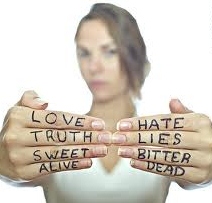 There really is no other hand. Look at both of your hands. They aren’t identical. Find the differences. Your hands invite comparison; hence, the expression commonly used to compare: on the other hand.
The right hand can do what the left hand cannot. The left hand can do what the right hand cannot. I’m not just referring to whether you can write or throw a ball with either hand. It’s about the positioning to your body. If you pick up a cup with your right hand, you cannot pick up the cup with your left hand using the exact same hand positioning. You have to adjust. When you use both hands to pick up a box, each hand serves a purpose in the position it’s made. You cannot replace the right hand with the left hand and achieve the exact same results. The right hand does what the right hand is intended to do. The left hand does what the left hand is intended to do. There is no other hand.
When you’re double-minded or double-hearted, you’re trying to accomplish two things that cannot be accomplished at once. You’re trying to occupy a space – in your heart or your mind – with more than one thing. One or the other will be sacrificed. There’s only so much space, and duplicity doesn’t fit.
My favorite verse about whole-heartedness and single-mindedness (because it’s convicting to me) is 1 Kings 18:21: Elijah approached the people and said, “How long will you not decide between two choices? If the Lord is the true God, follow him, but if Baal is the true God, follow him!”
Choose and follow. That’s it. (1) Decide. (2) Respond.
Belief and doubt. Action and inaction. God and self.
You can’t have it both ways. There is no other hand.